


Please note that we do not create all the designs featured in this article. Our primary focus is to curate and collect a diverse range of design collections and products to inspire and share with our audience. While we do not claim ownership or take full credit for the original designs and images, we occasionally make minor adjustments, particularly in home decor and fashion items, to present them more effectively. Additionally, we may produce and edit images to enhance their quality and composition before sharing them on our Pinterest page or website. For the design work we do on these creative designs, we also include our logo on the images shared on Pinterest and our website. This helps our audience recognize that these designs have been published on insiderlyfe.com!
Here is the test most stylists quietly run in their heads: if you cannot step out of the shower, scrunch once, and look put together, the cut is wrong for you, no matter how good it looked in the chair.
That is the whole idea behind a wash and go haircut. The shape does the work, so the blow dryer, the curling iron, and the extra ten minutes become optional instead of mandatory.
These nine looks cover short, medium, and long hair, from a textured pixie with round glasses to long layers that fall in a soft wave. Each one is described exactly as it appears in the photos, so you can save the closest match and show it to your stylist.
Most of them lean on the same three tricks: layers placed where hair already bends, a fringe or face frame that sits right without a brush, and an end shape that does not need a curl to look finished.
Do not skip number 4, the cut with the most surprising payoff for hair that never behaves, and stay for number 9, the one that asks the least of you before 8 a.m.
1. The copper shaggy bob that works with your cowlick

This short shaggy bob has a wispy fringe, feathered layers around the ears, and a warm copper tone that catches light like it was planned. The layers are cut at different lengths on purpose, so a bit of air drying creates movement instead of frizz. Because the outline is soft rather than blunt, a stray wave or cowlick reads as texture, not a mistake. It is a friendly cut for fine to medium hair that tends to lie flat.
Best for: fine or medium hair that needs lift without teasing.
Maintenance: a trim every 6 to 8 weeks keeps the feathered ends from going shapeless.
Styling tip: rake a little cream through damp hair with your fingers, then leave it alone. Touching it while it dries is what causes frizz.
2. Sleek long layers in deep chocolate brown
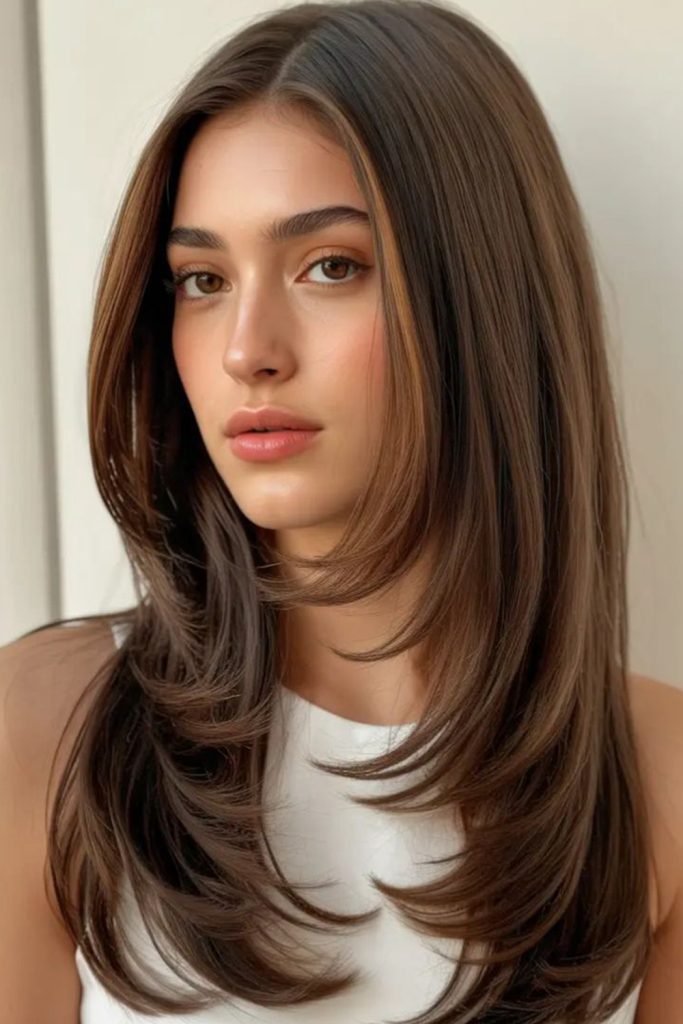
Long, straight, glossy hair in a deep chocolate shade, with layers that start near the collarbone and sweep forward around the face. Straight hair is the easiest to wash and go because there is nothing to coax into shape, but only if the layers are cut well enough to move. These do. The front pieces fall inward without a flat iron, and the length still looks full at the bottom. Dark brown also hides a day or two of skipped washing better than lighter shades.
Best for: straight hair that tends to look heavy or one-length.
Maintenance: a light gloss treatment every couple of months keeps the shine, and trims every 10 to 12 weeks are enough.
Styling tip: ask for the first layer to land at the chin so the face frame works without a blow dry.
3. Long loose waves with a sun-faded balayage
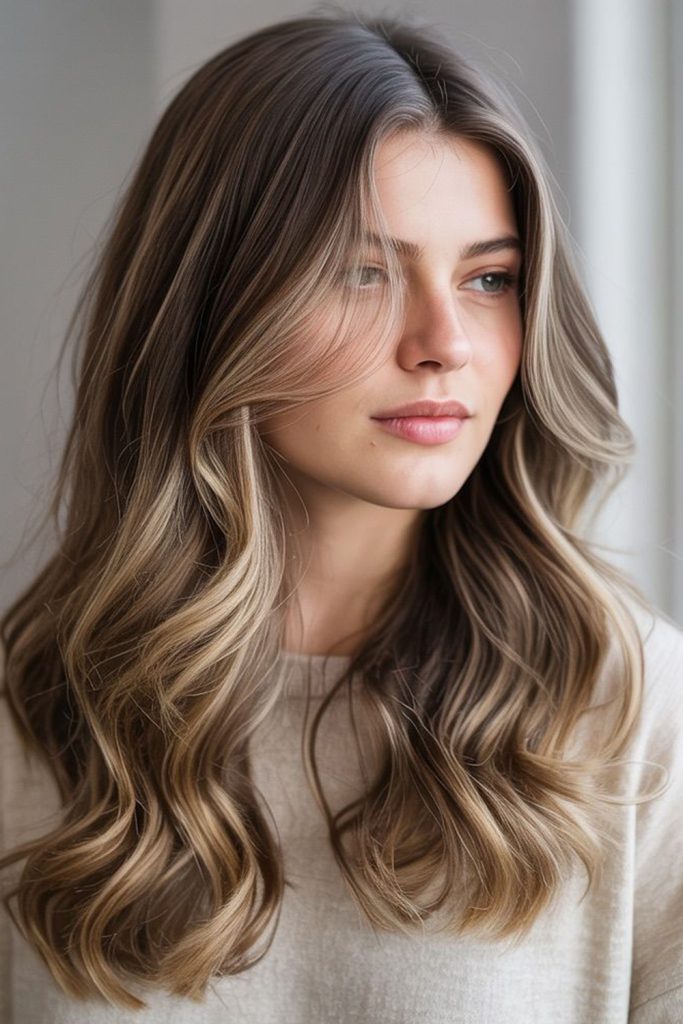
Dark roots melt into soft golden strands through the lengths, and the hair falls in loose waves that look almost accidental. The color is part of the wash and go strategy here: when highlights are painted on a gradient, regrowth is invisible and you can go months between salon visits. The waves are the kind that appear when layered hair dries naturally, not the kind made with a barrel. If your hair has any natural bend, this cut respects it.
Best for: wavy or slightly wavy hair that likes to be left alone.
Maintenance: a toning visit two or three times a year, and a bond-repair mask every few washes.
Styling tip: twist damp sections around your finger once and let them air dry for a more defined wave.
4. The textured pixie with round glasses
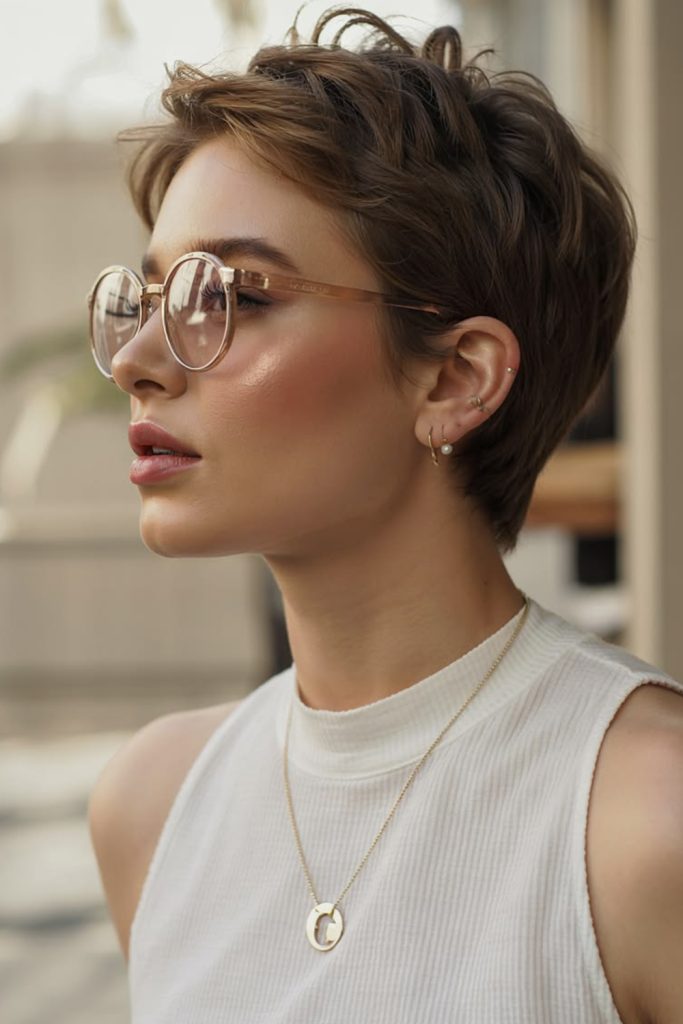
Number four is the surprise. A short, textured pixie looks high-effort but is arguably the lowest-effort cut on this list. The top is cut longer and piece-y, the sides stay close, and the whole thing dries into shape with fingers and a pea-sized amount of product. It also pairs well with glasses, as the photo shows, since there is no hair around the frames to fuss with. Hello! magazine, in a roundup of cuts that need little styling, lists the bixie among its low-maintenance picks, and the same logic applies to this pixie: their wash and wear cut guide is worth a read before your appointment.
Best for: anyone who wants zero morning routine and a strong, clean look.
Maintenance: the highest salon frequency on the list, around every 4 to 5 weeks, but the lowest daily effort.
Styling tip: bring a photo and ask for the top to be point-cut so it separates by itself.
5. A shaggy medium cut with soft curtain bangs

This is a medium cut with shaggy layers and curtain bangs that part in the middle and sweep to the sides. The bangs are long enough to tuck behind your ears when they bother you, which makes growing them out painless. The layers through the middle give the hair a lived-in shape even when it is slightly damp. The cut leans casual, a good match for a striped top and hoops, and it does not ask for a round brush at any point.
Best for: medium hair with a bit of natural wave and a relaxed wardrobe.
Maintenance: bangs need a quick trim every 4 weeks, which most salons do for free or cheap.
Styling tip: let the bangs dry first, parted down the middle, then leave the rest of your hair alone.
Halfway through, and the next few are the ones readers save most often. If you are not sure which length suits you, jump to the comparison table below.
6. Long soft layers with light brown curtain bangs
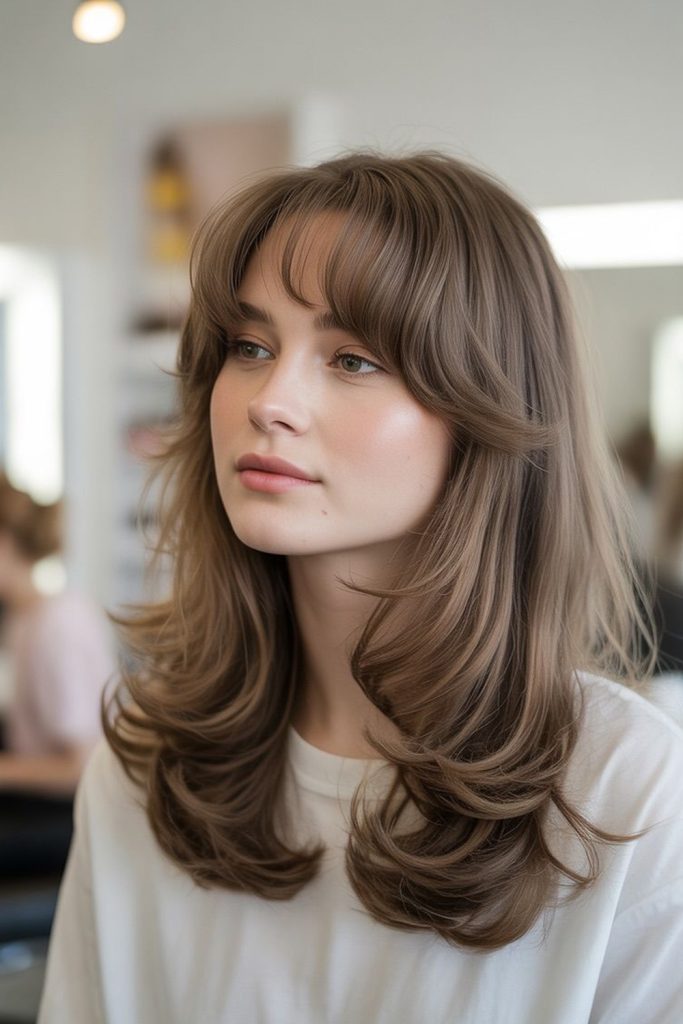
Light brown hair with long layers and curtain bangs that blend into the sides. The ends curve slightly inward, which is the detail that stops long layers from looking stringy. This cut looks polished on day one and relaxed on day three, so it handles a busy week gracefully. Because the layers are soft rather than choppy, the shape holds even if you never pick up a dryer.
Best for: long hair that feels flat and needs movement around the face.
Maintenance: a trim every 8 to 10 weeks, and a leave-in conditioner to keep the ends smooth.
Styling tip: sleep with your hair in a loose braid on wash day and take it out for an easy wave.
7. Long face-framing layers with lighter ends

The layers here start high, around the cheekbones, so the hair moves in front while the back keeps its length. The brown is slightly lighter at the ends, which shows off the layering without a heavy highlight. The result looks blow-dried but is mostly a cut doing the job. Hair with some natural body will fall into this shape alone, and thicker hair gets its weight reduced where it counts.
Best for: thick or heavy hair that needs weight removed.
Maintenance: a gloss or shine treatment twice a year is plenty.
Styling tip: comb through damp hair with a wide-tooth comb, then flip your head and let it dry upside down for volume.
8. Dark brown long layers with an off-center part
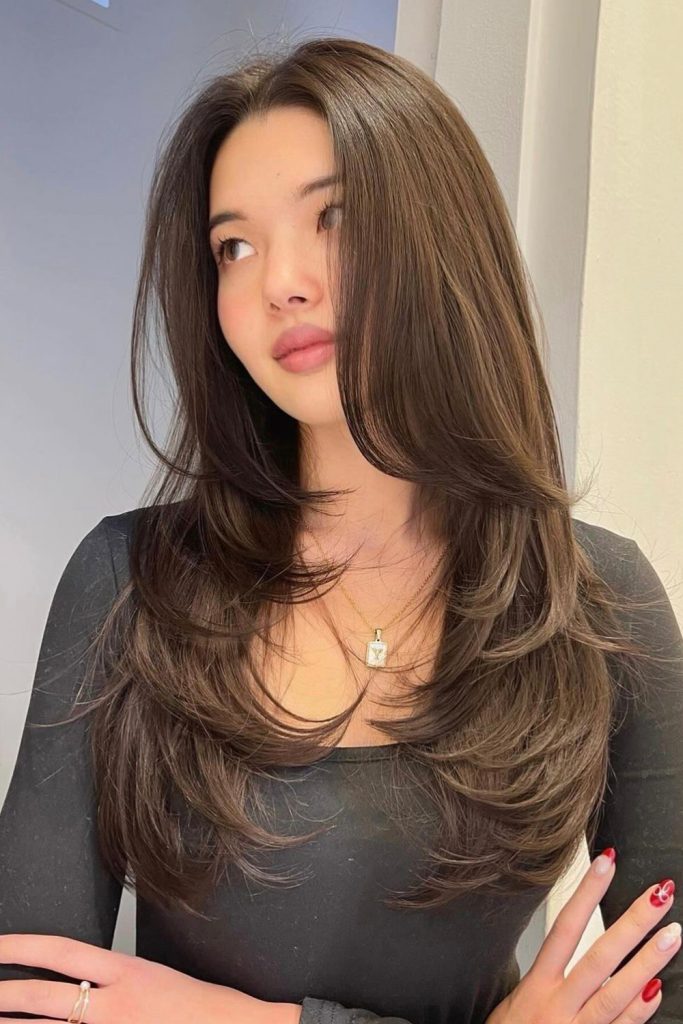
Long dark brown hair with layers that begin below the shoulders and an off-center part that does a lot of the styling. The layers are subtle enough to keep the length looking full, and the part gives lift at the crown. This is the cut to pick if you want to keep your length but are tired of the one-length weight. It dries straight to slightly wavy, so it fits most days without effort.
Best for: long, dark hair with a straight to slightly wavy pattern.
Maintenance: trims every 10 to 12 weeks, with a clarifying wash once a month.
Styling tip: flip your part to the other side once a week so it does not train flat.
9. The chin-length blunt bob that skips all styling

Number nine asks the least of you. A sleek, chin-length bob with a soft part and blunt ends, in a deep brown. There are no layers to coax and no fringe to train, so the cut either falls right or it does not, and a good bob falls right. Hello! magazine describes a flicked, one-length bob with a defined line as a modern wash and wear option, and this is the classic version of that idea. Straight or lightly wavy hair gets the best result.
Best for: straight, medium-thick hair and anyone who wants a polished look in five minutes.
Maintenance: frequent trims, every 5 to 6 weeks, because the line is the whole point.
Styling tip: part it where it falls naturally and let it dry; forcing a part is what makes bobs look fussy.
Wash and go haircuts compared at a glance
| Cut | Length | Daily effort | Salon visits |
|---|---|---|---|
| Copper shaggy bob | Short | Very low | Every 6 to 8 weeks |
| Textured pixie | Very short | Lowest | Every 4 to 5 weeks |
| Shaggy medium with curtain bangs | Medium | Low | Every 6 to 8 weeks |
| Long sleek layers | Long | Low | Every 10 to 12 weeks |
| Balayage waves | Long | Low | Color every 3 to 4 months |
| Chin-length blunt bob | Short to medium | Very low | Every 5 to 6 weeks |
What makes a haircut truly wash and go
A cut earns the label when it survives three tests. First, it should look intentional while damp, because that is how it spends the first hour of your day. Second, it should dry into a decent shape without a brush. Third, it should not depend on a single product. If you need a mousse, a serum, a heat protectant, and a diffuser, you are not getting a wash and go, you are getting a routine in disguise.
The shape matters more than the products. Hair with layers cut to follow its natural fall will curve in the right places. Hair with a hard line, like a blunt bob, relies on the line staying crisp. Both work, but they are different strategies, and it helps to know which one you are choosing.
Your hair type decides the rest. Very fine hair does well with a pixie or a bob because there is little weight to pull it down. Thick hair benefits from layers that take bulk out. Curly and wavy hair should be cut dry or at least checked dry, since curls spring up and change the length. If you want a deeper look at how a bob can be softened for easy days, our soft bob haircut ideas show several options.
What to say at the salon
Stylists respond best to specifics about your mornings, not just a photo. Try this script, adapted to the cut you chose:
“I want a cut that dries well on its own. I do not blow dry most days and I can spend about five minutes with my hands and one product. Can you add layers where my hair naturally bends and keep the ends soft so it does not need curling? Please show me how you would style it once, so I can copy it at home.”
Then ask two follow-ups: which products you really need, and how soon you should come back for a trim. A good stylist will give you a short list, not a shopping bag. If the answer is a dozen products, the cut may not be as easy as it looks.
What to expect in the first few weeks
- Week 1: the cut is at its best, and you are learning how it dries. Take notes on what you did and what happened.
- Week 2: the shape starts to settle. Bangs and short layers may need a small adjustment, and most salons will tidy them quickly.
- Weeks 3 and 4: you will find your routine, usually one product and a few seconds of scrunching or smoothing.
- Weeks 6 to 8: the line begins to soften. Bobs and pixies show growth first, long layers last.
- Week 10 and beyond: time for a trim, or a gloss if the color has faded.
Common mistakes that ruin an easy cut
The first is over-washing. Hair that is washed daily can lose its natural oils, and the cut will look limp. Try washing every second day and rinsing in between. The second is touching hair while it dries. Every time you run your hands through damp hair you break the wave pattern and add frizz. The third is skipping trims. A wash and go cut relies on its shape, and split ends blur the shape quickly.
The last is choosing a cut that fights your hair. If your hair is poker straight and you want a curly shag, you will be curling every morning. Pick a cut that matches what your hair already does, and the daily effort will drop. For more ideas on bangs that sit well without styling, see our guide to straight hair with curtain bangs, and for a messier, textured option take a look at curly shag haircuts with bangs.
Choosing your cut by hair type
- Fine hair: the pixie, the blunt bob, or the copper shaggy bob, since shorter shapes add body.
- Thick hair: long layers with lighter ends, because removing weight is the whole job.
- Wavy hair: the balayage waves or the shaggy medium cut, both of which follow a natural bend.
- Straight hair: sleek layers or the chin-length bob, where the cut does the shaping.
- Short on time: the pixie, which wins every morning, even though it needs the most frequent trims.
One more thing before you book: take a photo of your hair air-dried on a normal day and bring it along. Stylists can read your natural pattern from it in seconds, and it keeps the conversation honest about what the cut will really do. Many people discover their hair has more wave or more cowlicks than they remembered, and that information changes which of these nine you should pick.
It also helps to be upfront about your budget for upkeep. A pixie is cheap to style but needs frequent visits, while long layers cost more per visit but far fewer of them. Choosing the rhythm that suits your calendar matters as much as choosing the shape.
Frequently asked questions
Do wash and go haircuts work on curly hair?
Yes, but ask for the cut to be done with the curls in mind. A stylist who works with curls will cut the hair dry or check it dry, so the length lands where you want it after it springs up.
How often should I trim an easy haircut?
It depends on the shape. Pixies and bobs look best with a trim every 4 to 6 weeks, while long layers can wait 10 to 12 weeks.
Which products do I really need?
One. A lightweight cream or a leave-in conditioner is enough for most of these cuts. Add a texture spray only for the pixie or the shaggy bob.
Can I get a wash and go cut with thin hair?
Absolutely. Fine hair actually does well with blunt bobs and short textured cuts, since there is less weight to pull the style flat.
The short version
The best easy haircut is the one that agrees with your hair. Pick a length you can live with, bring a photo, describe your mornings honestly, and let the shape do its job. Save this list for your next appointment, and your hairdryer might get a well-earned rest.
Related Post