
Please note that we do not create all the designs featured in this article. Our primary focus is to curate and collect a diverse range of design collections and products to inspire and share with our audience. While we do not claim ownership or take full credit for the original designs and images, we occasionally make minor adjustments, particularly in home decor and fashion items, to present them more effectively. Additionally, we may produce and edit images to enhance their quality and composition before sharing them on our Pinterest page or website. For the design work we do on these creative designs, we also include our logo on the images shared on Pinterest and our website. This helps our audience recognize that these designs have been published on insiderlyfe.com!
You own a trench coat. It hangs by the door, it cost real money, and every morning you reach for the puffer instead, because the trench feels like it needs a plan.
That is the usual story. A trench looks effortless on other people because they have settled three small things: what goes under it, how the belt sits, and which shoe finishes the line. Get those wrong and the coat looks like a costume. Get them right and it quietly makes a ten minute outfit look considered.
This guide is for anyone who wants the trench to earn its place. Whether you have a camel classic that has lived in your wardrobe for years or you are about to buy your first, you will find ten complete outfits, from beige and black to jeans, dresses, loafers, boots, cold weather layering and the office.
Below the looks you will also find a quick guide to choosing the right trench, ready-made phrases for the shop, the mistakes that make a trench look dated, a fit guide by height, and a simple styling timeline for the season ahead.
One to watch for: number 8 is the layering formula that keeps a trench wearable well past the first frost, and most people never try it. Keep scrolling.
How to choose a trench coat that works with everything
A trench is a lightweight, belted coat with a double breasted front, a storm flap across the shoulder, and usually epaulettes and a wide collar that can be turned up. The original was built from cotton gabardine, a tightly woven, water resistant fabric developed in the late 1800s, and that sturdy, slightly crisp fabric is what gives a good trench its shape.
Four things decide whether it will work for you, and fabric and length matter most.
- Length: knee length is the most flexible, because it works over dresses and trousers alike. Midi length looks elegant but needs a heel or a slim boot to avoid swamping a petite frame.
- Fabric: cotton gabardine or a cotton blend is crisp and holds a collar. Polyester blends drape more softly and are usually lighter on the wallet. A wool blend trench trades rain resistance for real warmth.
- Colour: stone, sand and camel go with almost everything. Black is sharper and slimming. Olive and navy are quieter options once you own a neutral.
- Fit: you should be able to wear a fine knit under it and still raise your arms. If the shoulder seam sits past your natural shoulder, the proportions will read as borrowed.
Torn between a trench and something heavier? Our comparison of trench coat vs peacoat vs wool coat walks through which one suits which climate and wardrobe.
1. Classic beige trench with white tee and straight jeans
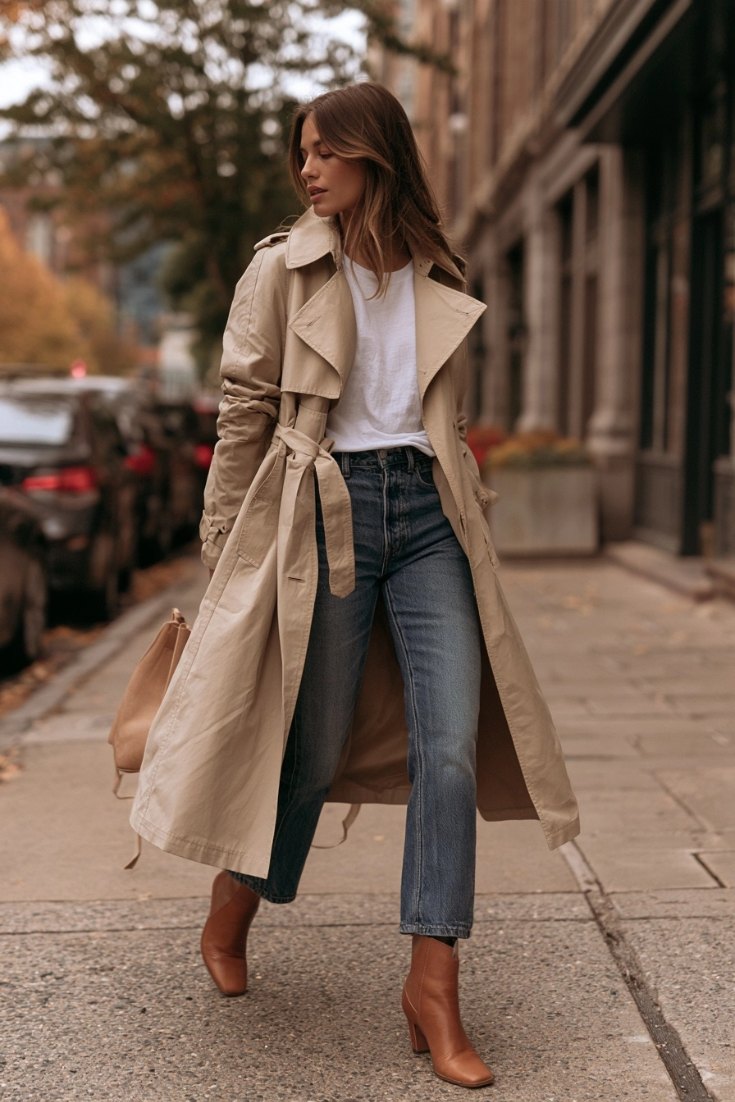
This is the trench in its natural habitat, and it is the outfit to master first. A stone or sand coloured knee length trench, a plain white tee and straight leg jeans in a mid wash.
The trick is contrast in texture. The crisp coat against soft cotton and denim keeps the look from feeling too tidy. Tie the belt in a loose knot rather than a buckle, and push the sleeves up once to show your wrist.
Finish with tan leather ankle boots or white leather trainers. Skip a bright bag, because the whole point is a calm palette of cream, blue and tan.
Best for: most heights and shapes. Skip it if your jeans are skinny and your trench is boxy, since the shapes fight each other. Choose a straight or relaxed leg instead.
2. Black trench with a grey knit and tailored trousers
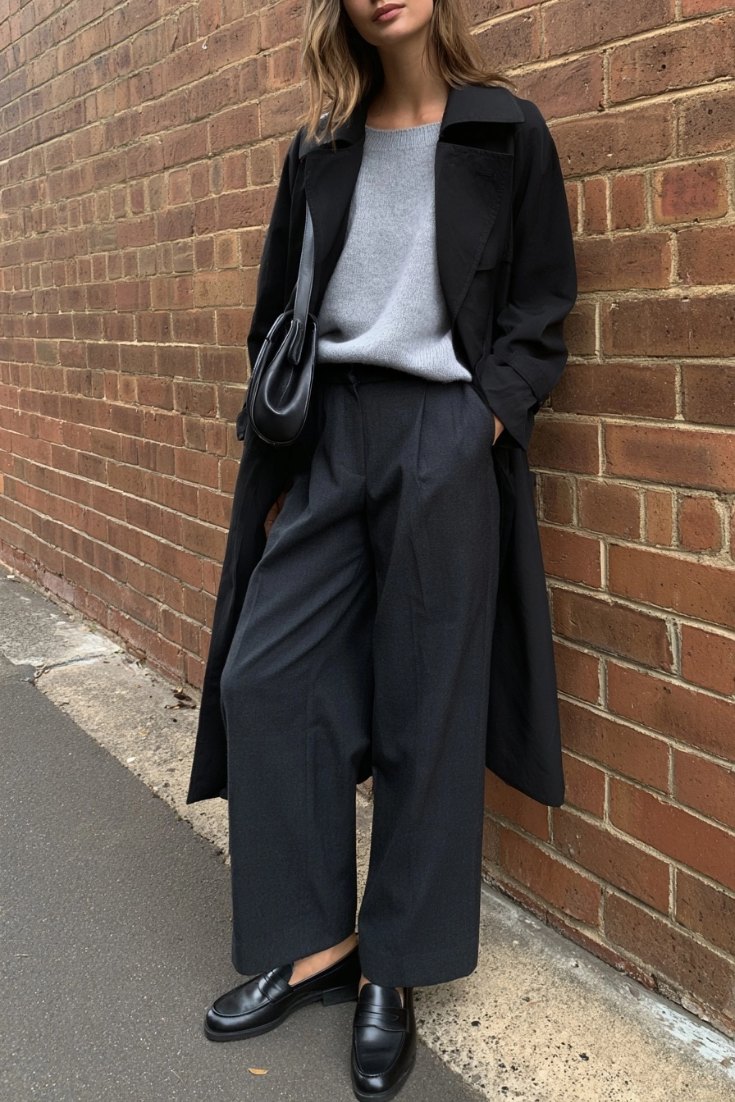
A black trench reads sharper and more modern than beige, and it is the easier choice if you wear a lot of dark colours. It also hides city grime, which matters by November.
Keep everything else tonal: a light grey merino sweater, charcoal tailored trousers with a slight break, and black leather loafers. The grey lifts the outfit so it does not become a wall of black.
A tip stylists often give: choose a black trench with a matte, slightly textured cotton finish rather than a shiny one, because shine can look like a rain mac.
Best for: office, travel days, and anyone who wants the trench to look slimming. Skip pure black if it drains your colouring near the face, and add a cream or soft pink scarf.
3. Belted vs open: the same trench worn two ways
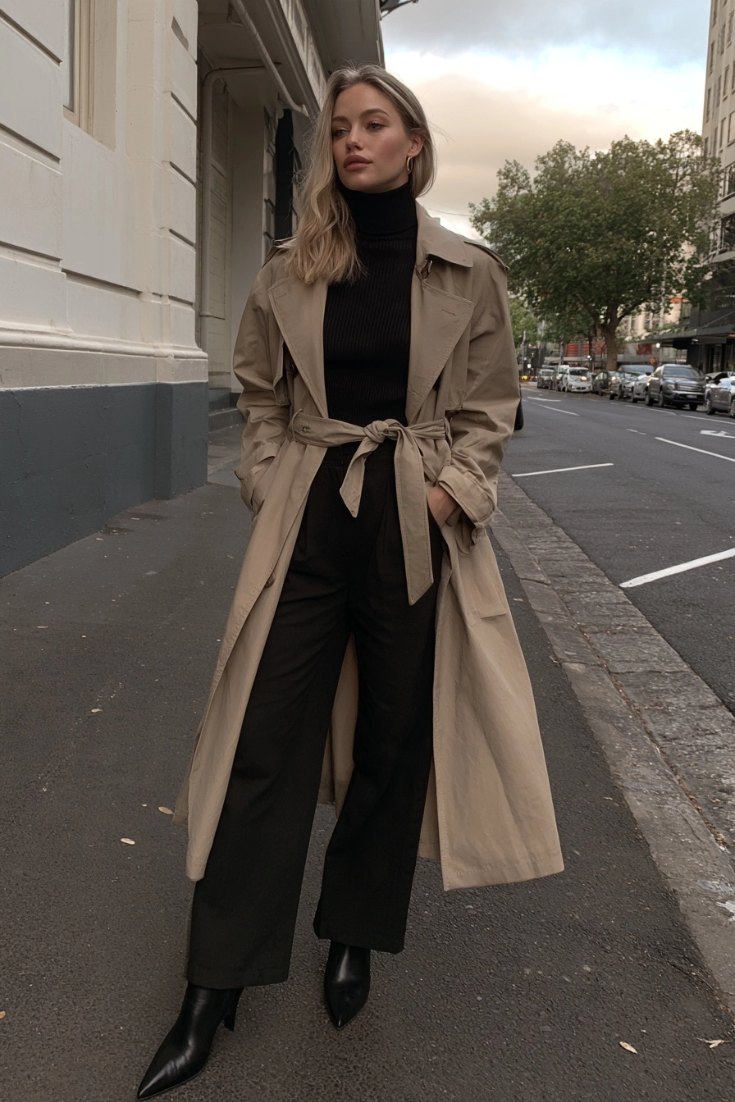
This one is a lesson rather than a single look, because the belt changes everything. Belted, the trench defines your waist and gives a clean hourglass line. Open, it becomes a long, easy column that elongates the whole body.
For belted, try the knot method: wrap the belt once, tie a simple overhand knot and let the ends hang. For open, drop the belt through the loops and let it hang loose at the back, or take it off entirely.
Wear the coat belted over slim shapes such as a fitted black turtleneck, and open over loose ones. Wide trousers plus an open trench is the combination that looks most current.
Skip belting if the coat is long and you are petite, since the cut can chop your legs. Wear it open or tie the belt behind the back.
4. Trench with jeans, a striped top and ballet flats
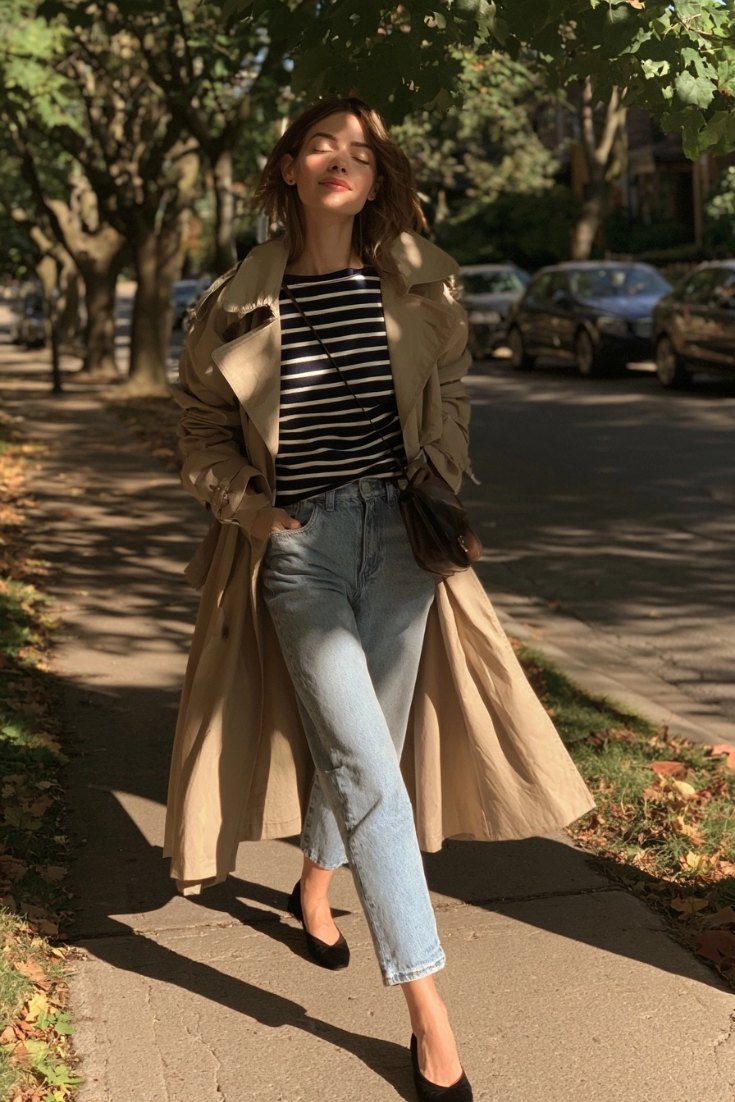
The Parisian shortcut. A navy and white Breton striped top, light wash cropped jeans and a sand trench worn open. It is the nearest thing to a uniform that never goes wrong.
Cropping your jeans just above the ankle lets the shoe show, which keeps the long coat from swallowing you. Black ballet flats or white leather trainers both work. If your trench is cotton, choose a slightly heavier striped top so the fabrics balance.
Add one gold piece, such as small hoops or a simple watch, and stop there. The charm of this outfit is that it looks like you barely tried.
Best for: weekend errands, coffee dates and travel. Skip it for formal events, where tailored trousers read better.
5. Trench over a slip dress or midi dress
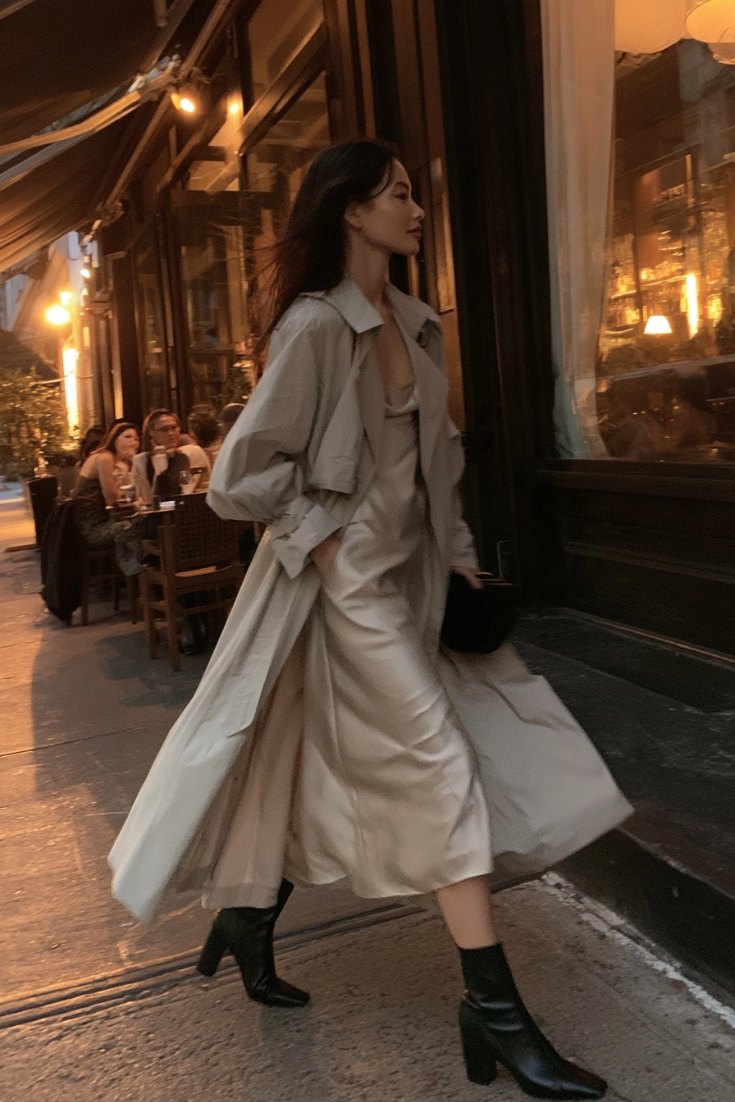
A trench is one of the few coats that does not fight a dress. Throw it over a satin midi slip dress in champagne or olive and the contrast of crisp and fluid fabric is quietly dressy.
Keep the coat shorter than the hem, or at least no longer than the dress by more than a couple of inches, so the dress still shows. For evening, add block heel ankle boots and a small clutch.
If the night is cold, wear a thin black roll neck under the slip dress as a layer and tuck the sleeves into the coat. It looks intentional and adds warmth without bulk.
Best for: dinner, theatre and holiday parties. Skip very clingy jersey, which can cling to the trench lining.
Halfway there. Next up is the loafer pairing that makes a trench look expensive, and after that comes the boot formula for rain.
6. Trench with penny loafers and cropped trousers
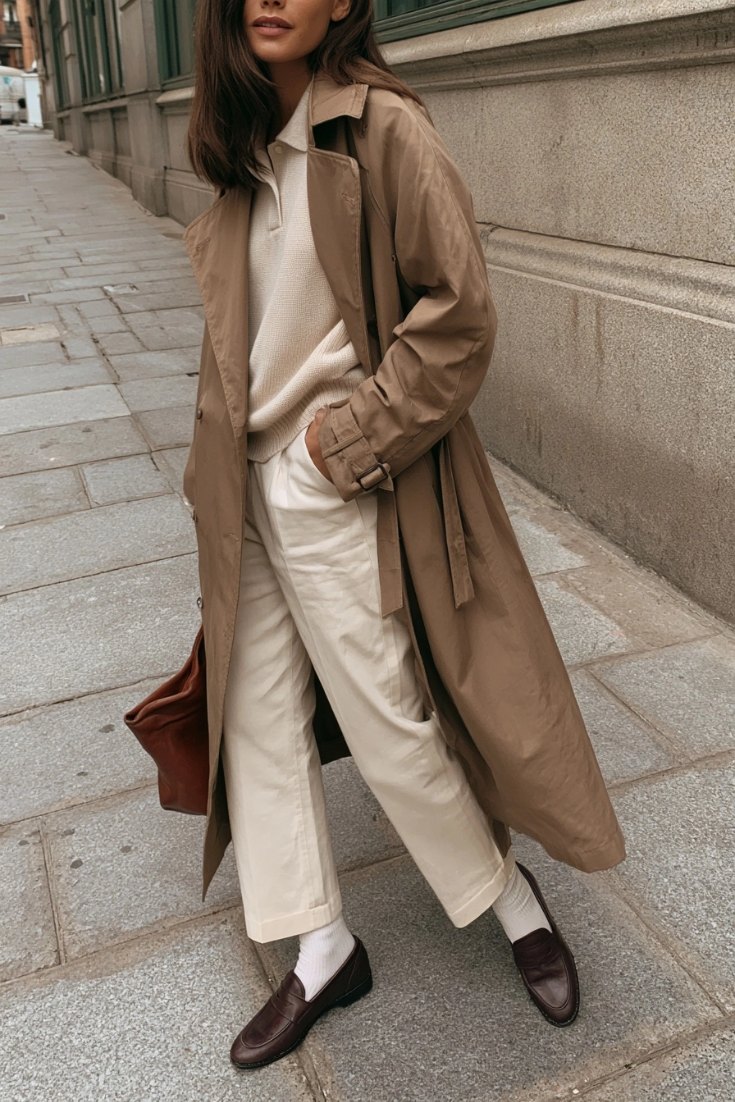
Loafers and a trench share the same heritage of understated tailoring, and together they look quietly preppy. Try dark brown penny loafers, white ankle socks, cream cropped trousers and a camel trench.
The socks matter. A visible white or cream sock fills the gap between hem and shoe and makes the outfit feel deliberate. Chunky soled loafers feel more current than flat slim ones and handle wet pavement better.
If you are still deciding which flat to buy, our guide to loafers vs ballet flats vs mary janes compares comfort, formality and how each one looks under a long coat.
Best for: office days and campus. Skip pale suede loafers on rainy days.
7. Trench with knee high boots
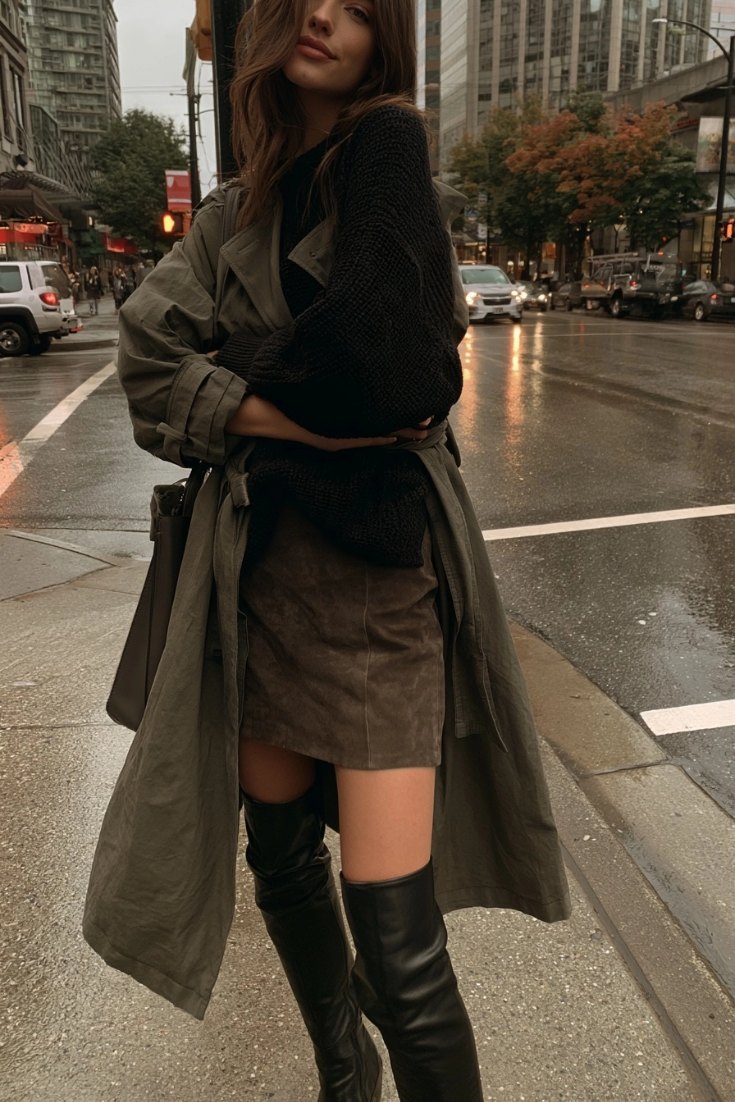
Knee high boots turn a trench into a statement. The coat falls to the knee, the boot rises to meet it, and the legs read as one long line. It also happens to be the most practical rain outfit in this list.
Pick a boot with a low block heel and a smooth leather finish, then wear a skirt or a dress that sits just above the coat hem. Black leather works with every trench colour, and brown suede looks rich against olive.
Our guide to knee high boot outfits for women covers fit, calf width and how to wear the boot under trousers if a skirt is too cold.
Skip suede in heavy rain, and choose a waterproof spray at the start of the season.
8. Cold weather layering: trench over a knit and a scarf
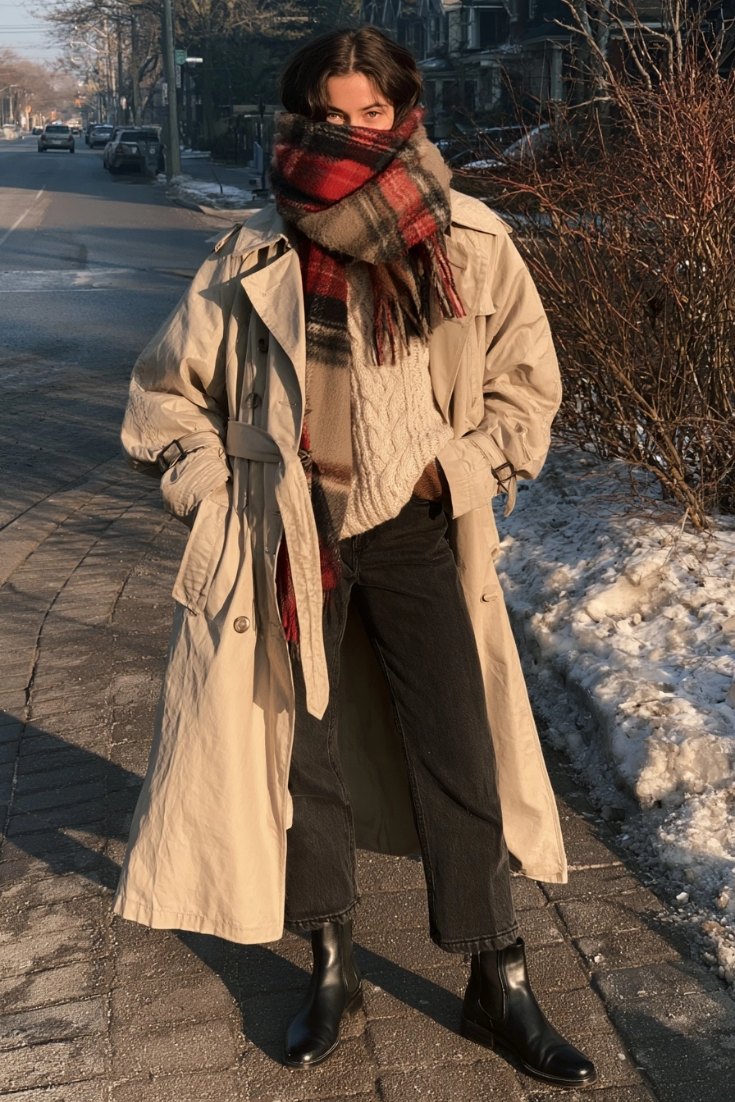
A trench is made for mild days, but with the right layers it works well into winter. The formula is thin on the inside, warm on the outside: a fine merino base, a chunky sweater, then the trench buttoned to the top.
Size matters here. If you plan to layer, buy the trench a size up or try it on over a thick sweater in the shop. A wool scarf tucked inside the collar closes the draught gap at the neck, and leather gloves finish the look.
For a snowy or freezing day, a trench with a removable warm lining, which many brands sell, is worth looking for. Otherwise move to a heavier coat.
For more ideas on cold season dressing, see our winter outfits for women.
Best for: autumn into early winter, and city commutes.
9. Trench with a sweater dress
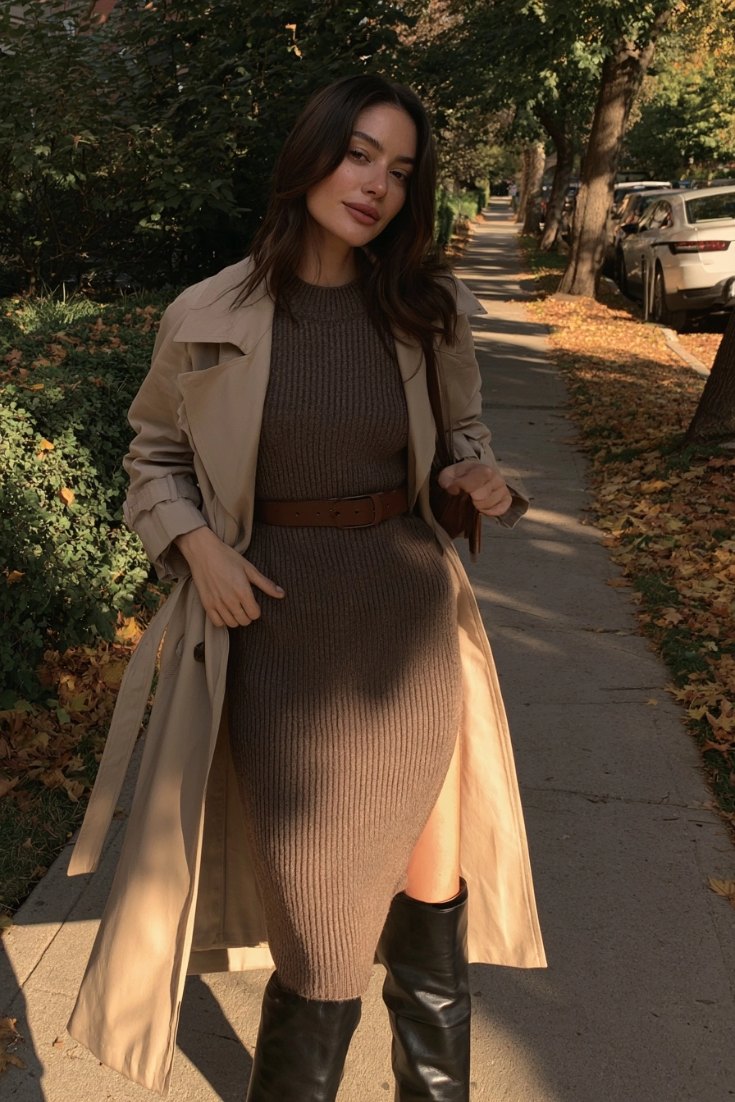
A knit midi dress under a trench is the lazy answer to the question of what to wear when it is cold but not quite coat weather. Pick chocolate brown, charcoal or oatmeal in a ribbed knit.
The trench sits over it as a clean outer layer. Wear the coat open so the dress shows, and add a slim belt over the dress if you want definition without cinching the coat itself.
Choose a dress hem that falls below the trench hem by an inch or two, or well above it. Matching hems look accidental. Tall boots in black or brown complete the look.
For more ways to wear knitted dresses, see these sweater dress outfits.
Skip very bulky knits, which bunch up under the arms of a fitted trench.
10. Trench for work: tailored, tonal and polished
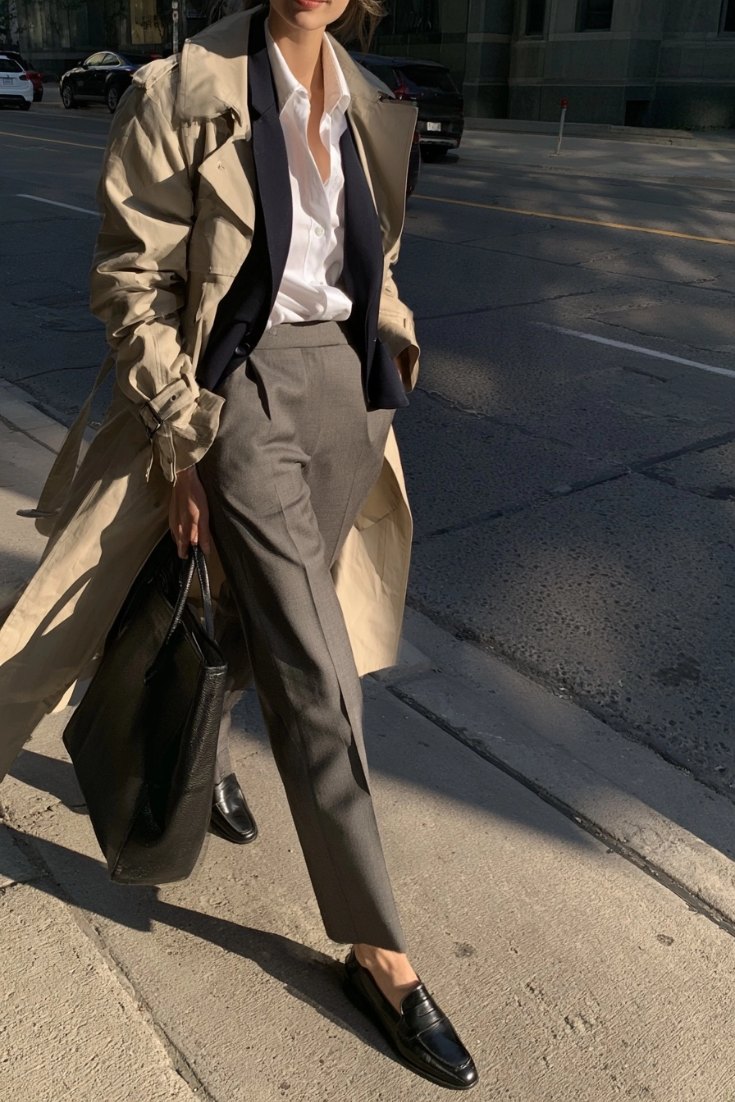
The trench was designed for officers, and it still looks most at home over a suit. Pair a stone coat with a navy blazer, a white shirt and grey tailored trousers.
Keep the blazer slim enough to move easily under the coat sleeve. A thin blazer in a fine wool will not bunch at the elbow the way a stiff one does. Choose a structured tote large enough for a laptop, and keep the colours to two or three.
A stylist’s tip: button the coat all the way for a meeting and leave it open in the lift. It changes how formal the outfit reads in seconds.
Best for: interviews, client days and long commutes. Skip a very short trench over a long skirt, since the proportions look unbalanced.
Three small tricks that change how a trench looks
Before the shop phrases, a few details that stylists use on set, because they cost nothing and change the whole silhouette.
- Turn the collar up at the back: it frames the face and adds height in the neckline, which is useful if you wear your hair up or a scarf underneath.
- Push the sleeves up once or twice: a quarter turn at the cuff shows your wrist and watch, and it stops a crisp sleeve from looking stiff.
- Tie the belt at the back for a looser line: pull both ends behind you, cross them and tie a small bow. You get a gentle shape without the pinch of a front knot.
None of these need a different coat. They just make the one you own look styled rather than simply worn.
Which shoe goes with which trench look
| Shoe | Works best with | Avoid with |
|---|---|---|
| Ankle boots | Jeans, wide trousers, midi dresses | Very long coats that cover the boot top |
| Loafers | Cropped trousers, tailored work looks | Ankle length skirts in thin fabric |
| Ballet flats | Cropped jeans, stripes, mini dresses | Wet pavement and heavy rain |
| Knee high boots | Skirts, dresses, slim trousers tucked in | Wide leg trousers that bunch at the calf |
| Trainers | Casual weekend looks and travel | Formal tailoring |
What to say when you shop for a trench
Trenches are all about the details, and shop staff respond well to specifics. Try these.
- “Can I try this over a thick sweater? I want to wear it all season.”
- “Is the fabric water resistant or just water repellent?”
- “Does it come in a regular and a long length? I need it to hit the knee.”
- “Can the lining be removed, or is there a warm version?”
- “Can you show me the belt loops and the buttons? I want to check they are sewn on firmly.”
Common trench coat mistakes and how to fix them
- Buying a size that only fits over a tee: try it over your thickest knit, or go up a size.
- Wearing the belt tight and the collar flat: loosen the knot and turn the collar up for a more relaxed line.
- Pairing a short trench with a long skirt: match the proportions by choosing a coat that sits at or just below the knee, or wear the skirt shorter.
- Skipping the iron: creases and a limp collar age the coat, so steam it each season.
- Wearing it only when it rains: it is a year round layer, so use it as a light jacket on dry days too.
Which trench suits your height and shape
| Your build | Best trench length | Styling tip |
|---|---|---|
| Petite (under 5ft 4in / 163cm) | Just above the knee | Wear it open or tie the belt high, and keep shoes close to your skin tone |
| Average height | Knee length | Belted or open both work, so try both in the mirror |
| Tall (5ft 9in / 175cm and over) | Mid calf or midi | Wide trousers and a long open trench look best |
| Curvy | Knee length with a belt | Look for a defined shoulder and a belt that sits at your natural waist |
| Straight or athletic | Boxy knee length | Belt it at the waist to create shape |
Colour matters too. Warm skin tones suit camel, sand and olive. Cool skin tones suit stone, grey beige and navy. Deep skin tones look great in rich camel, black and cream.
Your trench styling timeline
- Early autumn: wear it open over a tee or a light knit with jeans.
- Mid autumn: add a fine merino sweater and ankle boots, and belt it.
- Late autumn: swap in a chunky knit, a wool scarf and gloves, and button it to the top.
- Winter: use a warm lining if you have one, or save the trench for milder days.
- Spring: go back to open and light, with a dress and flats.
Colour pairings that always work with a trench
If you are not sure what to put under or beside the coat, start with a palette. A trench is a neutral, so it plays well with almost anything, but some combinations feel more finished than others.
- Camel or stone with navy and white: the classic, and the safest choice for work or travel.
- Black with grey and cream: modern and tonal, and easy to build from pieces you already own.
- Olive with chocolate brown and ivory: an earthy autumn palette that looks richer than it sounds.
- Beige with a single bright accent: a red scarf, a cobalt bag or a pink knit, as long as you keep to one.
Whichever palette you pick, repeat one colour twice, for example in a bag and a shoe, so the outfit looks planned rather than assembled.
Trench coat outfits FAQ
Can you wear a trench coat in winter?
Yes, on mild winter days or with layers. A thick sweater and scarf underneath will help, as will a version with a warm lining. In freezing weather a wool coat is the better choice.
Should a trench coat be belted or open?
Both are correct. Belt it when you want to show your shape, and wear it open over loose or long outfits. Knotting the belt rather than buckling it is the softer, more modern way.
What colour trench coat is most versatile?
Stone, sand and camel go with the widest range of outfits and skin tones. Black is the next most flexible, especially for work.
How long should a trench coat be?
Knee length is the easiest to style. Go a little shorter if you are petite and longer if you are tall. The hem should ideally not fall at the widest part of your calf.
Is a trench coat waterproof?
Most are water resistant rather than fully waterproof, meaning they handle light rain but not a downpour. Check the label, and use an umbrella in heavy rain.
Found the trench look you would wear first? Save this article to your Pinterest board so you can pull it up in front of the wardrobe on the morning you need it.
Related Post