

Please note that we do not create all the designs featured in this article. Our primary focus is to curate and collect a diverse range of design collections and products to inspire and share with our audience. While we do not claim ownership or take full credit for the original designs and images, we occasionally make minor adjustments, particularly in home decor and fashion items, to present them more effectively. Additionally, we may produce and edit images to enhance their quality and composition before sharing them on our Pinterest page or website. For the design work we do on these creative designs, we also include our logo on the images shared on Pinterest and our website. This helps our audience recognize that these designs have been published on insiderlyfe.com!
A teacher costume has a harder job than a party costume. It has to survive six hours, three year groups and a duty rota, stay appropriate in front of parents, and still let you kneel down next to a desk.
That rules out most of what turns up in Halloween guides. No masks, nothing trailing, nothing you cannot move in, and nothing that needs explaining to a seven year old twice.
These fifteen all pass that test. Each one says what to wear, how it holds up across a full day, and whether it works for younger or older students.
What Makes a Costume Classroom-Ready
Your face stays visible. Younger children in particular need to see their teacher’s face, and anything covering it changes how they respond to you. Makeup is fine, masks are not.
You can move properly. Kneeling, reaching, sitting on a low chair, walking the corridor at speed. If a costume fails any of those, it fails the day.
It reads in one second. You will be identified by hundreds of children, most of them in passing. Recognition has to be instant or you spend the whole day answering the same question.
It survives the staff room and the school gate. Parents will see it. So will your head teacher. That is the real test most costume guides ignore.
1. Bookworm
Cardigan, glasses, a stack of books under one arm, and a scarf. Add a name badge with the title of a favorite book.
Across the day: perfect. It is ordinary clothing, so nothing restricts you and nothing needs adjusting between lessons.
Best for: every age group, and particularly good for English teachers who want a costume that doubles as a conversation about reading.

2. Apple of the Classroom
Red top or dress, a green scarf or headband as the stalk, and a brown belt. Simple, bright and immediately understood.
Across the day: excellent, provided you skip any padded or structured apple shape. Flat red reads just as clearly and lets you sit down.
Best for: primary classrooms. Younger children respond to the bright single color more than to anything detailed.

3. Everyday Superhero
A shirt worn open over a bright emblem tee, glasses, and a tie loosened at the neck. The half-changed look is the whole costume.
Across the day: very good. You can button the shirt up completely for a meeting or the school gate and become invisible again.
Best for: all ages. It is the most adaptable costume on this list.

4. Historical Figure
Period-appropriate clothing kept simple, one strong signature accessory, and a small card explaining who you are for the children who ask.
Across the day: depends entirely on the figure. Choose someone whose look is mostly ordinary clothing rather than robes or armor.
Best for: older students, and an easy way to make the costume part of an actual lesson.

5. Puzzle Piece
A plain top with a large felt puzzle piece on the front, and a second piece for a colleague so the two interlock when you stand together.
Across the day: excellent. Flat felt on ordinary clothes means nothing to carry and nothing to catch.
Best for: teaching assistants and co-teachers. It is the only costume here designed to be worn as a pair.

6. Friendly Witch
A black dress or skirt, a hat, and striped tights. Keep the makeup light and the whole thing cheerful rather than sinister.
Across the day: good, though the hat will come off during anything active. Have somewhere to put it.
Best for: primary, with the caveat that some younger children find witches genuinely frightening. Keep it bright and smiling.

7. Animal Ensemble
A one-color outfit matching the animal, ears on a headband, and a drawn nose and whiskers. Nothing more than that.
Across the day: very good. The headband is the only thing to manage and it survives a full day easily.
Best for: early years and lower primary, where this is reliably the most popular costume in the building.

8. Famous Scientist
A white lab coat over normal clothes, goggles pushed up on the head, and wild hair. A clipboard finishes it.
Across the day: excellent, and the lab coat comes off in one movement if you need to look ordinary.
Best for: all ages, and the obvious pick for science teachers who want the costume to do some work.

9. Crayon or Pencil
A single strong color head to toe with a pointed card hat in the same shade, and a paper band around the middle with the color name on it.
Across the day: good. Keep it flat rather than building a tube, or you will not be able to sit at your desk.
Best for: primary, and excellent as a whole-department costume where each teacher takes a different color.

10. Pumpkin
Orange top or dress, a green scarf or headband, and a brown belt. The same formula as the apple in a different palette.
Across the day: excellent, as long as nothing is padded. Flat orange is comfortable and reads perfectly well.
Best for: every age. It is the most seasonally obvious costume here and the least likely to need explaining.

11. Literary Detective
A long coat, a checked cap or hat, a magnifying glass and a notebook. Understated and instantly recognizable.
Across the day: good, though the coat is warm indoors. Plan to take it off between lessons.
Best for: upper primary and secondary, and a good hook for a reading or inference lesson.

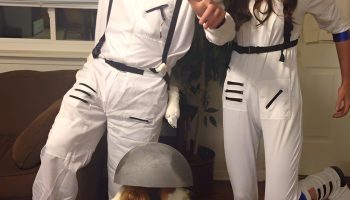
12. Space Explorer
A jumpsuit or boiler suit with foil badges, boots, and a patch on the shoulder. No helmet.
Across the day: very good. Boiler suits are comfortable, warm and cover whatever you are wearing underneath.
Best for: primary, and a strong choice if you are teaching anything about space that week.

13. Fairy Tale Character
One clearly identifiable element, a red hood, a blue pinafore, a single glass-effect shoe, worn with otherwise plain clothing.
Across the day: excellent, because the costume is one item rather than a full outfit.
Best for: early years and lower primary, where recognition is instant and delight is guaranteed.

14. Weather Forecast
A blue or gray outfit with cotton wool clouds and card raindrops attached, plus an umbrella and a pointer.
Across the day: good. Attach the clouds flat rather than hanging, or they catch on everything in a corridor.
Best for: primary, and genuinely useful for anyone teaching weather that term.

15. Food-Inspired Costume
One food item interpreted through color and a simple shape. A slice of something, a favorite fruit, a breakfast item, kept flat and bright.
Across the day: good, provided you resist anything three-dimensional. Padded food costumes cannot sit at a desk.
Best for: all primary ages. Food costumes reliably get the biggest reaction and the most questions.

Five That Work With No Preparation at All
The bookworm, the everyday superhero, the famous scientist, the literary detective and the fairy tale character all run on clothes most teachers already own plus one accessory.
That matters because the last week of October is not a week when teachers have spare evenings. Every one of those five can be assembled the morning of, in under ten minutes.
If you want the absolute minimum, the bookworm is it. A cardigan, glasses and a stack of books, all of which are probably already in your classroom.
Keeping It Appropriate
Skip anything gory, bloodied or genuinely frightening. Even in secondary, the same costume passes through corridors shared with much younger children, and duty on the gate puts you in front of parents.
Avoid masks and heavy face paint entirely. Beyond the recognition problem, face paint transfers onto whiteboards, worksheets and children, and it will not survive until three o’clock.
Check anything that might read as a cultural stereotype. If you are unsure, that uncertainty is your answer, and there are fourteen other options on this page.
And keep one plain layer available. A cardigan or shirt that turns the costume off in one movement is genuinely useful for meetings, difficult conversations and anything unexpected.
Frequently Asked Questions
What is the easiest teacher costume to put together?
The bookworm. A cardigan, glasses and a stack of books, all of which are usually already in the classroom, and it takes under five minutes.
What works for secondary students?
The historical figure, the literary detective and the famous scientist. All three are understated enough to avoid teenage scepticism and can be tied into actual lessons.
Can I wear a costume on playground duty?
Yes, if you can move and see properly in it. The space explorer, the bookworm and the animal ensemble all handle a cold playground and a full duty without trouble.
How do I make sure it stays school appropriate?
Nothing covering the face, nothing gory, nothing that could read as a stereotype, and one plain layer you can put on to neutralize the whole thing in a second.
The Bottom Line
A good teacher costume is ordinary clothing plus one clear signal. That is why the simplest options on this list are also the ones that last until home time.
Pick something you can kneel in, keep your face visible, and choose recognition over detail. The children are identifying you from across a corridor, not examining your accessories.
For home, see the DIY couple costume guide, these trio costumes for a staff group, or these family costumes with a baby. Finish with some Halloween nails.
Related Post