

Please note that we do not create all the designs featured in this article. Our primary focus is to curate and collect a diverse range of design collections and products to inspire and share with our audience. While we do not claim ownership or take full credit for the original designs and images, we occasionally make minor adjustments, particularly in home decor and fashion items, to present them more effectively. Additionally, we may produce and edit images to enhance their quality and composition before sharing them on our Pinterest page or website. For the design work we do on these creative designs, we also include our logo on the images shared on Pinterest and our website. This helps our audience recognize that these designs have been published on insiderlyfe.com!
Everyone obsesses over the cut, then walks out with whatever colour the salon suggests. Here is the thing: the same bob looks like a completely different haircut in honey blonde, copper or inky black, and the colour can matter more than the length.
A bob is a short, simple shape, so there is nowhere for the colour to hide. That is good news, because it also means a small change, like a brighter piece at the front, can change the whole look.
Below are six bob colours shown on real cuts, with what they take to keep up, who they flatter, and exactly what to say to your colourist. Pay special attention to number 2, the face framing highlight, because it is the cheapest way to refresh a bob, and number 3, since copper fades the fastest.
Bob colours at a glance
| Colour | Effect | Upkeep level |
|---|---|---|
| Honey blonde blunt bob | Bright, polished, warm | Medium: toner every 6 to 8 weeks |
| Dark bob with a face framing highlight | Contrast around the face | Medium: touch up the front pieces |
| Copper bob | Warm, vivid, eye catching | High: fades quickly |
| Dark brown wavy bob | Rich and natural | Low |
| Warm mid brown wavy bob | Soft and approachable | Low to medium |
| Jet black messy bob | Sharp, cool, chic | Medium: gloss for shine |
1. Honey blonde on a blunt bob: clean and polished

A blunt bob and a warm blonde are a classic pairing. The straight, even ends show off the colour, and the warm tone looks soft and flattering up close to the face.
The photo shows how the light catches the surface and gives the blonde dimension, even in a single tone. That glossy finish is what makes it look expensive.
Blondes need care. Keep the ends trimmed, and use a gloss or toner when the shade starts to drift.
Best for: straight, fine to medium hair and anyone who wants a bright, polished finish.
Upkeep: Plan a toner or gloss every 6 to 8 weeks, and a trim every 6 to 8 weeks to keep the line sharp.
Ask your colourist: “A warm honey blonde with a glossy finish, and a blunt cut.”
2. A face framing highlight on a dark bob: the cheat code
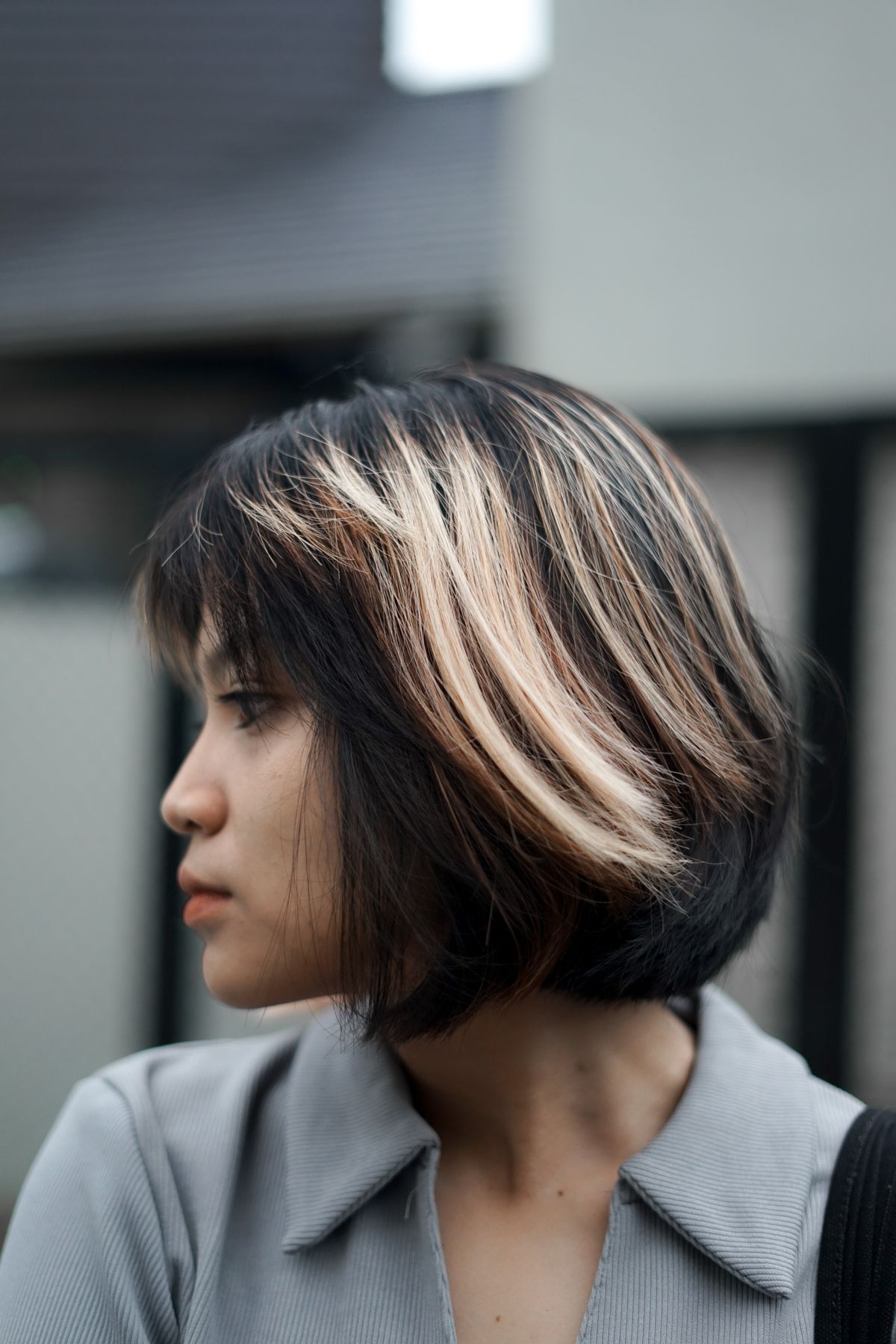
This is the most fun idea on the list. A dark bob with bright pieces around the face makes the cut feel modern, and it draws the eye to your features.
It is also a great way to try blonde without committing to it everywhere. The colour sits at the front, so the back stays dark and easy to maintain.
The contrast is strong, so ask your colourist to place the pieces carefully. Too thick, and it can look heavy, and too thin, and you may not notice it.
Best for: dark hair that needs a lift, and anyone who wants colour with less upkeep.
Upkeep: Touch up the front sections as they grow out, usually every 8 to 12 weeks.
Ask your colourist: “Face framing highlights on a dark base, blended well and not too thick.”
3. Copper on a sleek bob: warm, bold and brief

Copper is the colour that makes people turn their heads. On a sleek bob, it looks sharp and rich, and it stands out against neutral clothes like this white turtleneck.
The honest part is that reds and coppers fade faster than most shades. If you want to keep the colour looking fresh, plan to use colour depositing products and wash with cool water.
If you want a copper that looks natural, ask for a shade within a few levels of your natural colour.
Best for: warm skin tones and anyone who loves a statement shade.
Upkeep: Use colour safe shampoo, wash less often, and book a gloss refresh every 4 to 6 weeks.
Ask your colourist: “A copper shade that suits my skin tone, with a plan to keep it fresh.”
4. Dark brown on a wavy bob: easy, rich and wearable

A deep brown wavy bob is the easiest colour to wear. It reads as natural, it suits almost every skin tone and it shows off the movement in the waves.
The wave is what makes this look special. Light bounces across each bend, which gives the brown a lot more depth than a flat colour would.
A gloss every few months keeps the shine, and it is a low cost way to make a simple colour look expensive.
Best for: anyone who wants low maintenance, natural looking colour.
Upkeep: Low upkeep. A gloss every 8 to 12 weeks and regular trims keep it fresh.
Ask your colourist: “A rich brown with shine, and a cut that works with my natural wave.”
5. Warm mid brown on a chin length wave: friendly and soft

This warm, softer brown has a friendly, easy feel. The loose waves frame the face, and the shade has a little warmth that makes skin glow.
It is a good choice if you want a change without a big commitment. Moving from a natural brown to a slightly warmer brown is a gentle step.
Light waves are also forgiving. A little frizz or an uneven end is hidden by the movement.
Best for: a soft refresh and natural looking colour.
Upkeep: Low to medium upkeep. A gloss every 8 to 10 weeks adds warmth.
Ask your colourist: “A warm mid brown, one or two shades from my natural colour.”
6. Jet black on a messy bob: sharp and cool

Black hair looks bold on a bob, particularly with an undone, tousled finish. The centre part and the uneven ends keep it from feeling stiff.
Black is also a high shine colour when it is healthy. A gloss and a good conditioner will make it look glass smooth.
If you are going from lighter to black, the AAD says going darker is generally gentler than going lighter, so it is a safer move than a big lightening.
Best for: people who want a sharp, cool, high contrast look.
Upkeep: Medium upkeep. A gloss every 8 weeks keeps it shiny, and roots show as they grow.
Ask your colourist: “A natural looking black with plenty of shine.”
How to choose your bob colour in four questions
- How much upkeep do you want? Low upkeep means shades close to your natural colour, like the brown bobs. High upkeep means bright blondes and coppers.
- What is your natural colour? The AAD suggests staying within three shades of your natural colour, because lightening more than that needs stronger products and causes more damage.
- What do you wear most? Neutral clothes let a bold colour shine. Colourful wardrobes often look better with a calmer shade.
- What is your budget? A single colour with a gloss costs less than highlights, and highlights cost less than a full colour change.
What bob colour costs
Prices vary a lot by city and salon, but as a rough guide, an all over colour often costs around $70 to $150 in the US or about £50 to £100 in the UK, while highlights or face framing pieces are often around $100 to $300, or £70 to £200 in the UK. A gloss usually adds around $30 to $70, or £25 to £50.
Do not forget the upkeep cost. A copper that needs a refresh every month costs more over a year than a brown that only needs a gloss every few months.
Colour and cut: which pairs work best
| Cut style | Colour that shows it off | Why |
|---|---|---|
| Blunt, straight bob | Honey blonde, black, copper | Clean edges show the colour clearly |
| Wavy bob | Dark or mid brown | Waves add depth to rich tones |
| Bob with a fringe | Face framing highlights | The colour sits right around the eyes |
| Tousled, undone bob | Jet black or dark brown | The mess adds an edge |
| Sleek bob with a side part | Copper or auburn | The shine shows off warm tones |
Colour safety and care: what dermatologists say
Before any dye goes near your head, read the American Academy of Dermatology’s coloring tips. It advises testing store bought colour before use, following the manufacturer’s instructions, and not dyeing your hair if you notice a rash, redness, swelling, burning or itching. See a dermatologist for allergy testing if that happens.
The AAD also says that sun exposure can make hair weak, dry and brittle, especially after dyeing or bleaching, so wear a wide brimmed hat outdoors. If you colour at a salon, ask your colourist about patch testing, and tell them about any past reactions.
How to keep your bob colour looking fresh
- Wash less often: hot water and frequent washing fade colour faster.
- Use a colour safe shampoo: gentler formulas help hold the shade.
- Use a gloss: a clear or tinted gloss adds shine and refreshes the tone between appointments.
- Protect from the sun: a hat is a simple way to prevent dryness and fading.
- Trim regularly: a bob depends on a crisp shape, so book a trim every 6 to 8 weeks.
How to style each bob so the colour shows
- Blunt blonde bob: blow dry smooth with a round brush, then finish with a light shine serum on the ends.
- Dark bob with highlights: a side part pushes the bright pieces forward, and a centre part spreads them evenly.
- Copper bob: keep the surface sleek, since smooth hair reflects more colour than frizzy hair.
- Wavy brown bob: scrunch in a light cream while damp, and air dry for soft, defined waves.
- Black bob: run a tiny amount of oil through the ends for a high shine finish, then tousle with your fingers.
A good style makes the colour look richer, so spend a minute on the finish. A smooth surface or a defined wave will show off your shade far better than a rushed dry.
Photos versus real life
Inspiration photos are often edited, shot in perfect light or styled by a team. That does not mean you cannot get the look, but it does mean your result may look a little different in your own bathroom mirror.
Ask your colourist to look at your photo and tell you honestly what is realistic for your starting colour and hair condition. A good colourist will explain what can be done in one visit and what might take two.
If you are unsure, start with a smaller step, like a gloss or face framing pieces, and build from there. It is far easier to add colour than to take it away.
Growing out a bob colour gracefully
- Choose a root friendly shade: colours close to your natural shade grow out with the least fuss.
- Ask for a soft root blend: a gentle shadow at the root hides regrowth for longer.
- Book touch ups early: a small visit before the colour fades is cheaper than a big correction later.
- Use a gloss in between: a gloss refreshes shine and tone without a full colour appointment.
What to say to your colourist (copy and paste this)
“I have a [cut] and my natural colour is [colour]. I would like [shade], and I want to know how often it will need a refresh. Could we keep it within three shades of my natural colour, and do a patch test first?”
This gives your colourist everything they need: the cut, your starting point, the goal, the upkeep and your safety questions. Bring photos, ideally of the shade in daylight.
What to expect after your colour appointment
- Day 1: the colour may look slightly brighter than it will settle. This is normal.
- Week 1: the shade settles. Wash gently and avoid hot water.
- Week 4: warm shades like copper start to fade, so consider a gloss.
- Week 8: time for a trim and a toner or gloss, especially for blondes.
- Week 12: roots and face framing pieces may need a touch up.
Bob colour mistakes to avoid
- Going too light too fast: the AAD notes lightening more than three shades causes more damage, so go gradually.
- Skipping the patch test: never risk a reaction for the sake of convenience.
- Choosing by photo only: light changes colour. Check your inspiration in daylight.
- Forgetting upkeep: choose a shade you will actually maintain.
- Ignoring the cut: a colour on a bad cut will never look its best, so book a trim too.
If you are still deciding on the shape, our guide to soft bob haircuts is a good start, and our comparison of the French bob vs Italian bob will help you pick between two popular shapes.
Save this: bob haircut colour cheat sheet
Screenshot it, print it or keep it on your phone. It has the key details from this guide in one place.
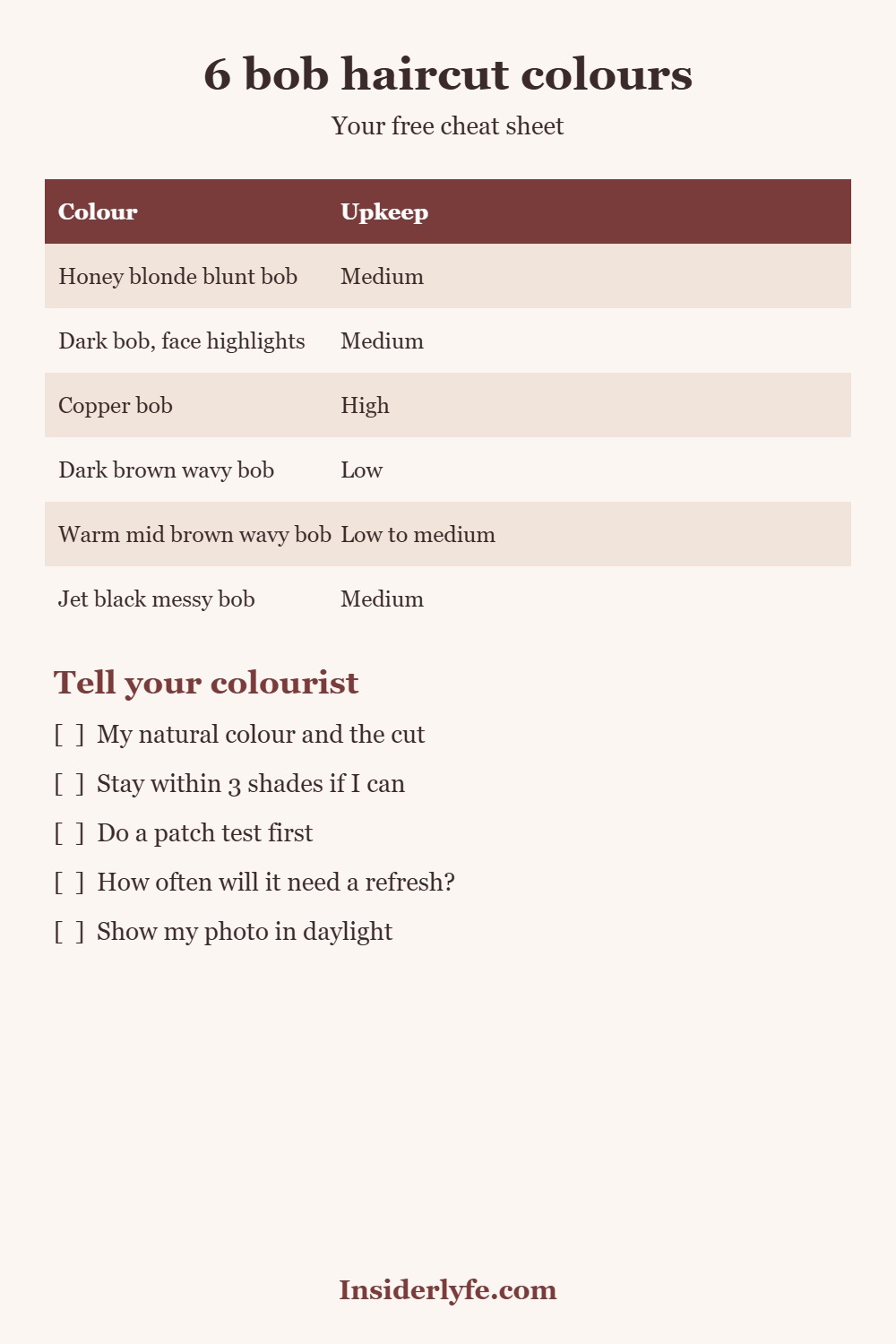
Download the full-size chart (free, no email needed)
If you only change one thing
Not ready for a big colour decision? Start with a gloss. It deepens your natural colour, adds shine and gives your colourist a chance to see how your hair takes colour. It is a low risk way to feel out a new shade.
Next, consider the front. A few brighter or warmer pieces around the face change the entire look of a bob without touching the rest of your hair. If you love the result, you can go further at your next visit, and if you do not, it grows out gently.
Whatever you pick, schedule your next appointment before you leave the salon. Colour looks best when it is looked after, and a booked slot keeps you on track.
Frequently asked questions
What colour looks best on a bob?
There is no single best colour, but shades within a few levels of your natural colour are the easiest to maintain, while blondes and coppers need more upkeep.
How often should I colour a bob?
It depends on the shade. Brown shades may only need a gloss every couple of months, while blondes and coppers often need a refresh every 4 to 8 weeks.
Do face framing highlights suit dark hair?
Yes. A dark base with brighter pieces around the face adds contrast and brightness, and the upkeep is usually lower than an all over colour.
Is it safe to dye my hair at home?
The AAD advises testing store bought colour before use, and stopping if you notice a rash, redness, swelling, burning or itching.
Does a bob colour damage hair?
Lightening can, especially by more than three shades, according to the AAD. Going darker is generally gentler, and a gloss adds shine without much risk.
One last tip: take a photo of your colour in daylight a week after your appointment and save it in your phone. It becomes your reference for next time, and it helps your colourist match the shade exactly.
Final thoughts
Pick the colour you will enjoy for the next few months, not just the one that looks best in a photo. Bring pictures, ask about upkeep and do the patch test.
Which bob colour would you try first, and which one are you saving for next season? Tell us in the comments.
Related Post